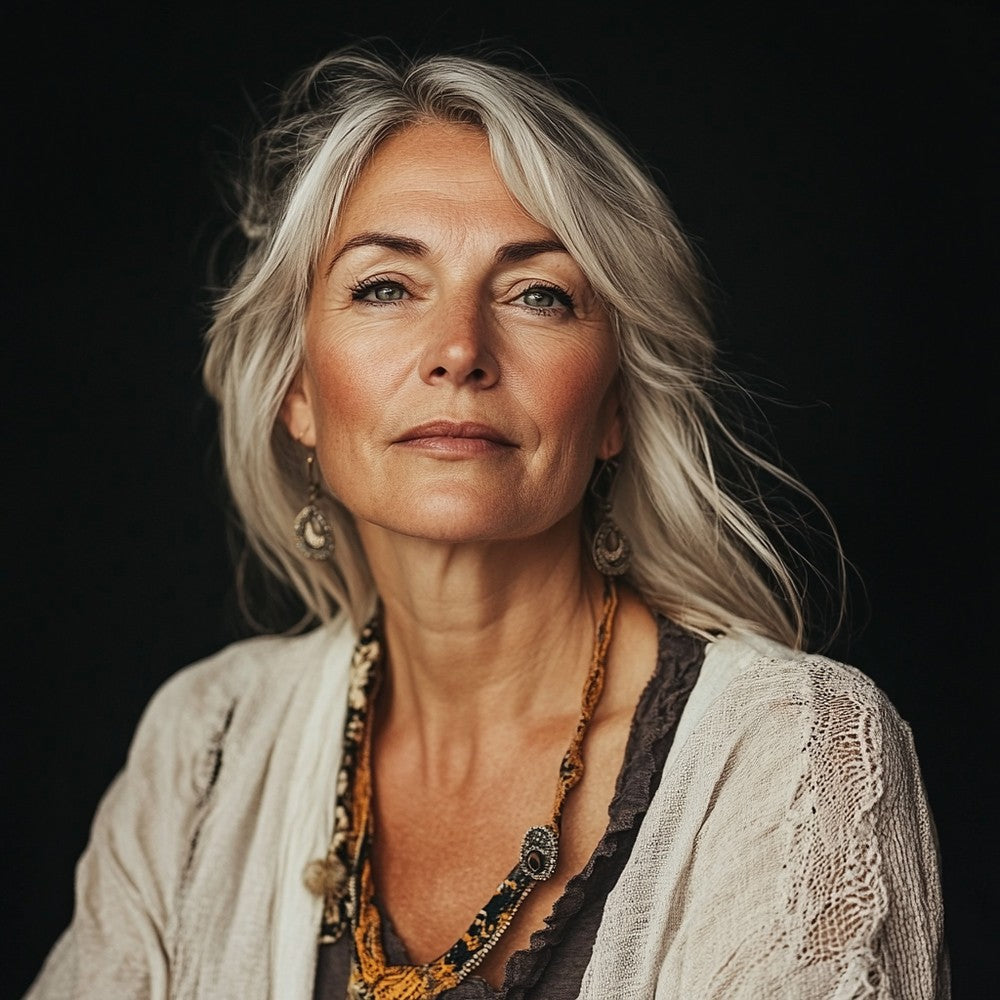

The gray showed up along your part first. Then at the temples. Then one morning you caught your reflection in a shop window and thought, huh, that's a lot of silver. And instead of booking a color appointment, you found yourself searching for long gray hairstyles with bangs. Good. You're in very good company.
Gray hair is not a problem to solve. It's just hair that stopped making pigment. According to the American Academy of Dermatology, hair turns gray or white when follicles stop producing melanin, and on average that starts in our 30s and 40s. By midlife, plenty of us are holding a decent share of silver whether we planned to or not. The question isn't whether to hide it. The question is how to wear it so it looks like a choice, because it is one.
Why gray hair acts like it has its own opinions
If your silver strands seem to stick straight up or frizz in ways your old hair never did, you're not imagining it. Gray hair is stiffer and more wiry than hair rich in pigment, and scientists still don't fully understand why. One explanation laid out by Encyclopaedia Britannica: with age, the follicle produces less pigment, but also fewer lipids and growth factors, which can leave hair coarser and harder to manage.
Dermatologists and stylists interviewed by NBC Select say much the same thing in plainer terms: gray hair tends to be drier and more textured, partly because the scalp makes less oil. Less oil means less natural smoothing and more vulnerability to damage. Rude, honestly. But useful to know, because it changes how you cut bangs and how you care for long lengths.
Long gray hairstyles with bangs that play nicely with silver
Bangs sit right at the front of your face, which means they take the most handling, the most heat and the most scrutiny in the mirror. With coarser gray texture, a few styles are much easier to live with than others.
- Curtain bangs: parted in the middle and swept to each side, longer at the edges. They blend into long layers, forgive a cowlick and grow out gracefully. Probably the easiest starting point if you've never had bangs.
- Long side-swept fringe: one longer piece angled across the forehead. Good for a strong part or a cowlick that refuses to lie flat.
- Wispy, piece-y bangs: thinned out so you can see forehead through them. Lighter weight means less puffiness when gray texture wants to stand up.
- Blunt, heavy bangs: dramatic and very chic on sleek, straight silver. Also the highest maintenance. Wiry strands make the line harder to keep crisp, so ask your stylist honestly whether your texture will cooperate.
- Long shag with bangs: choppy layers plus a fringe. Wavy or curly gray hair often looks fantastic this way because the cut works with the texture instead of fighting it.
A practical tip for the appointment: wash and style your hair the way you actually wear it on a Tuesday, then show up like that. Your stylist needs to see your real cowlicks and your real wave pattern, not the blowout you get twice a year.
Bangs as a bridge while you grow out color
If you're moving from dyed hair to natural gray, the line where the old color meets the new silver can feel very loud. Bangs help. A fringe cut from the newest growth at the front puts your real color right where people look first, and it makes the grown-out lengths behind it read as a deliberate contrast.
Some women go cold turkey and cut short first. Others keep their length and let a stylist add highlights or lowlights to soften the contrast while the silver comes in. Both are fine. Start wherever you are. If you're leaving dye behind partly because your scalp reacted to it, that's worth knowing too: the AAD notes that para-phenylenediamine (PPD), an ingredient found in many dark hair dyes, is a common cause of allergic reactions that make the scalp itch.
Keeping silver bright instead of brassy
Gray and white hair can pick up a yellow cast over time, which is annoying when you've finally decided to love the silver. Stylists quoted by NBC Select point to pollution, UV exposure, hard water, heat styling and product buildup as common culprits.
Purple shampoo is the usual fix. Violet pigment counteracts warm, yellow tones. The same experts suggest using it about once a week, alternating with a regular shampoo, and leaving it on wet hair for three to five minutes before rinsing and conditioning. Overdo it and you can end up with an ashy tint, so treat it like a seasoning, not the main course.
Sun counts here too. The AAD says lighter hair, including gray, is more vulnerable to UV damage. On long beach or garden days, a wide-brimmed hat is the simplest move. Hair products with SPF exist as leave-in sprays and conditioners. If you swim, a leave-in conditioner or a little oil before you get in the pool acts as a barrier against chlorine, and rinsing right after helps.
Care for long lengths when your hair is drier than it used to be
Long gray hair has been on your head for years by the time it reaches your shoulder blades. The ends are the oldest, driest part. The AAD's hair care advice for fragile hair reads like a cheat sheet for silver:
- Use a gentle shampoo and condition after every wash. A leave-in conditioner or detangler cuts down on breakage and frizz.
- Blot with a microfiber towel instead of rubbing. It speeds drying so you need less time under the blow-dryer.
- Keep the blow-dryer on its lowest heat setting, and save flat irons and curling irons for special occasions.
- Skip hot-oil treatments. The heat can damage hair that's already fragile.
- Brush gently, only as much as you need to style.
For ingredients, dermatologists and stylists commonly recommend humectants like glycerin, which draw in moisture, and conditioning oils such as argan. Some also suggest sulfate-free and silicone-free formulas, since silicones can build up and add to that yellow tone over time. None of these are magic. They just help hair that has less natural oil hold onto the moisture it has.
Bangs live right against your forehead, next to your moisturizer, sunscreen and whatever else you put on your face. If they start looking limp a day or two before the rest of your hair does, you can rinse or dry-shampoo just the fringe between full washes. Five minutes, and the whole style looks fresher.
Easy on the ponytails
Long hair invites the quick scrape-back ponytail on busy days. That's fine now and then. But the AAD warns that hairstyles that pull hard and often, like tight buns and ponytails, can cause traction alopecia, a type of hair loss from repeated tension that may become permanent. Gray hair that's already a bit fragile doesn't need the extra stress. Looser styles, soft scrunchies and claw clips are kinder, and a claw clip with face-framing bangs left out looks intentional anyway.
When bangs are covering more than a style choice
Sometimes women ask for bangs because the hairline seems to be creeping backward. Most of the time that's ordinary midlife thinning, which the AAD says often shows up as a widening part and sometimes a receding hairline. Worth a conversation with a dermatologist if it bothers you, but not an emergency.
There's one pattern worth taking more seriously. Frontal fibrosing alopecia is a scarring type of hair loss that mostly affects women after menopause, often appearing 2 to 12 years after menopause begins. It looks like a thin band of bald skin along the front and sides of the hairline. According to the AAD, between 80% and 95% of women diagnosed have lost some or all of their eyebrows, and eyebrow loss is often an early sign. Because scarred follicles can't regrow hair, earlier treatment matters. If your new bangs are hiding a hairline that keeps moving and your brows are thinning at the same time, book a dermatologist.
Otherwise? Get the bangs. Let the silver catch the light. If you hate them, they grow out in a few months, and in the meantime you'll have learned something about your own hair. That's a pretty good trade.