
Minoxidil
Ingredient · In our Minoxidil Tablet, Follicle Fix and Hair Regrowth Capsule
Minoxidil
Minoxidil started out as a blood pressure pill, and hair growth turned out to be one of its side effects. Today it comes as an over-the-counter scalp solution or foam, and doctors also prescribe it as a low-dose tablet.1,2

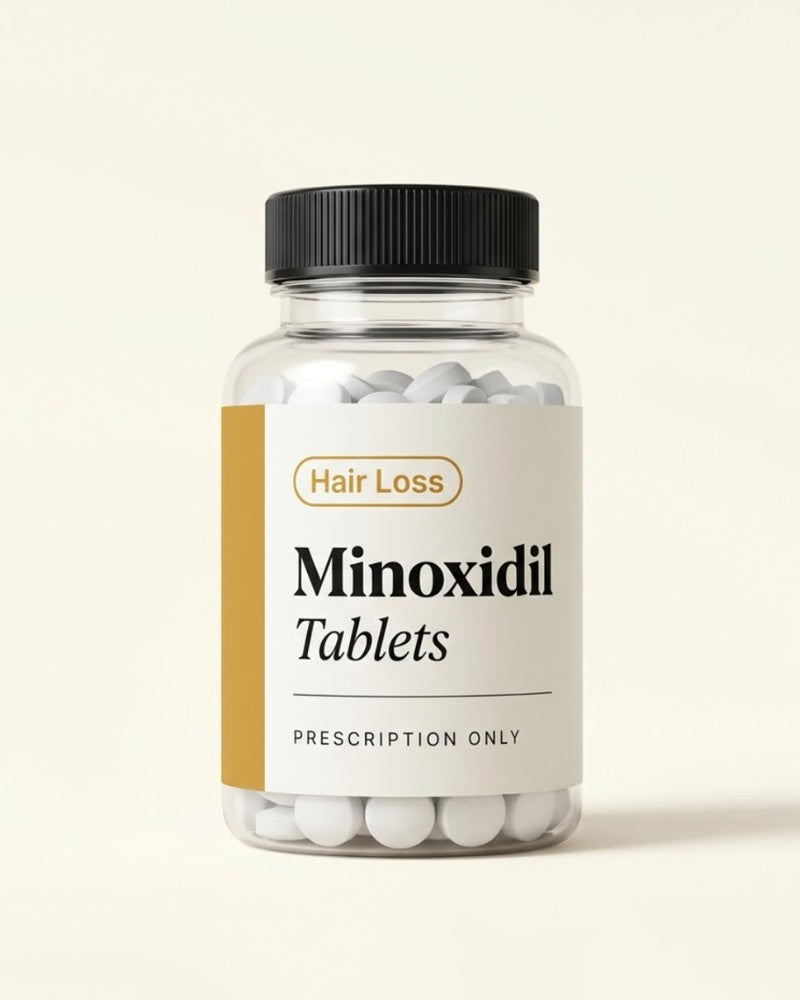
Photos are illustrations, not the medicine. Minoxidil is made in a lab.
Minoxidil applied to the scalp is FDA-approved, over the counter, to regrow hair on the top of the scalp in women.1 Minoxidil tablets are FDA-approved only for hard-to-treat high blood pressure, so a low-dose tablet for hair is off-label, meaning it's a clinician's judgment call rather than an approved use.2 Our Follicle Fix and Hair Regrowth Capsule are compounded by a licensed pharmacy, and compounded versions are not FDA-approved.6
The studies below used FDA-approved products or other forms. Our compounded version hasn't been studied in trials, and results may differ.
What it is
Hair grows in cycles: a growing phase, a resting phase, then shedding. Minoxidil helps follicles stay in the growing phase longer. In tablet form it also relaxes and widens blood vessels, which is why it was first used for blood pressure.2
Why it's in this product
Thinning at the part or crown is common in midlife. Of the 47 trials in a Cochrane review of female pattern hair loss, 17 tested minoxidil.3 We offer it as a low-dose tablet, in a scalp solution, and in a daily capsule, so you and your clinician can pick the format that fits your life.
What the studies in people show
- Systematic reviewAbout twice as likely to see regrowth on the scalp versionA Cochrane review pooled trials in women with pattern hair loss. With minoxidil applied to the scalp, 157 of 593 women reported moderate to marked regrowth, compared with 77 of 555 on placebo. The reviewers rated this moderate-quality evidence.3
- Meta-analysisThe low-dose tablet performed about like the scalp versionFour randomized trials with 279 people compared oral minoxidil with the scalp solution. Hair density and thickness improved similarly. Extra body or facial hair was about twice as common with the tablet.4
- Safety study1,404 people on low-dose tabletsIn a large multicenter review of people taking low-dose oral minoxidil for hair loss (two-thirds were women), the most common side effect was extra hair growth (15.1%). Lightheadedness (1.7%), fluid retention (1.3%) and a fast heartbeat (0.9%) were less common, and 1.2% stopped because of them. No life-threatening effects were reported.5
What we don't know yet
Most low-dose tablet studies are small or look back at past patients, and the trials comparing tablets with the scalp version are short. Results take time either way: the over-the-counter label says to give it about 6 months.1 Long-term data on the low-dose tablet is still limited.
Safety, in plain English
On the scalp, minoxidil can cause scalp irritation, redness or unwanted facial hair. The label says to stop and ask a doctor if you get chest pain, a racing heartbeat, faintness, dizziness, sudden unexplained weight gain or swollen hands or feet.1 At the much higher doses used for blood pressure, minoxidil tablets carry a boxed warning about serious heart effects such as fluid around the heart.2 Hair-loss doses are much lower, and no life-threatening effects were reported in the large safety study,5 but your clinician will still review your heart health and blood pressure.
A licensed clinician reviews your health history and decides whether minoxidil is appropriate for you. Exploring it here never means you'll get a prescription.
Curious about minoxidil?
Start with a free assessment. A licensed clinician reviews your health history and decides whether treatment is appropriate. No pressure, and no prescription unless it makes sense for you.
See Minoxidil TabletHow care worksSources
- U.S. National Library of Medicine, DailyMed. Women's Rogaine (minoxidil) 5% topical aerosol foam: drug facts label. DailyMed
- U.S. National Library of Medicine, DailyMed. Minoxidil tablets: prescribing information. DailyMed
- van Zuuren EJ, et al. Interventions for female pattern hair loss. Cochrane Database Syst Rev. 2016;(5):CD007628. PubMed 27225981
- Sobral MVS, Moreira JLML, Rodrigues LK, et al. Efficacy and safety of oral minoxidil versus topical solution in androgenetic alopecia: a meta-analysis of randomized clinical trials. Int J Dermatol. 2025;64:479-484. PubMed 39425514
- Vañó-Galván S, et al. Safety of low-dose oral minoxidil for hair loss: a multicenter study of 1404 patients. J Am Acad Dermatol. 2021;84:1644-1651. PubMed 33639244
- U.S. Food and Drug Administration. Compounding and the FDA: Questions and Answers. FDA
Sources checked November 8, 2026. This page is general education, not medical advice, and it doesn't mean any treatment is right for you. Photos: Unsplash (Wolfgang Weiser, Moh Sabik).