

Semaglutide
Ingredient · In our Semaglutide Injection
Semaglutide (the active ingredient in Wegovy and Ozempic)
Semaglutide is a GLP-1 medication. It acts like a hormone your gut releases after you eat, one that helps with fullness, appetite and blood sugar. The FDA-approved version has been tested in large, long trials.1,2

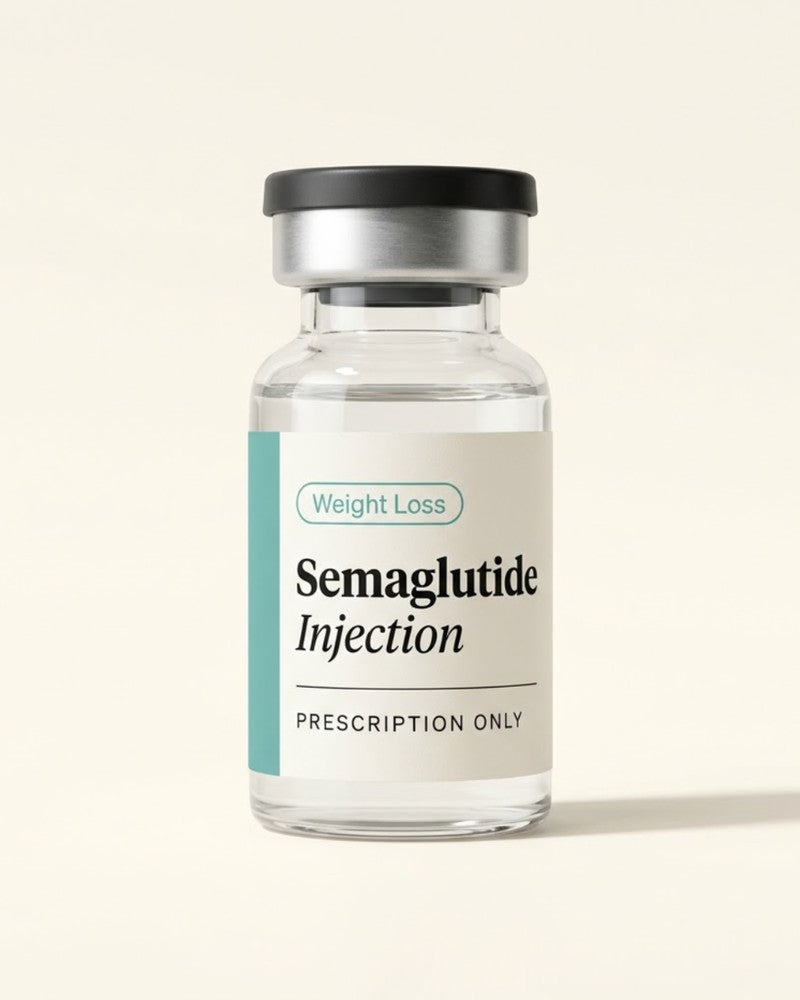
Photo is an illustration, not the medicine. Semaglutide is made in a lab.
Semaglutide is FDA-approved for long-term weight management in adults with obesity, or overweight plus a related health condition, as Wegovy.1 Our semaglutide is compounded by a licensed pharmacy, and compounded versions are not FDA-approved or reviewed by FDA for safety, effectiveness or quality.6,7
The studies below used FDA-approved products or other forms. Our compounded version hasn't been studied in trials, and results may differ.
What it is
Your gut makes a hormone called GLP-1 after you eat. It tells your brain you're full, slows how fast your stomach empties, and helps your body release insulin when blood sugar rises. Semaglutide is a longer-lasting version of that signal, which is why it's given once a week.1,2
Why it's in this product
It's the active ingredient in our Semaglutide Injection. The FDA-approved version has large, long trials behind it, described below. Your clinician decides if it fits.3,4
What the studies in people show
- Randomized trialAbout 15% average weight loss over 68 weeksIn a trial of 1,961 adults with obesity or overweight (without diabetes), weekly FDA-approved Wegovy (semaglutide 2.4 mg) plus lifestyle support led to an average 14.9% drop in body weight, compared with 2.4% on placebo.3
- Randomized trialFewer heart attacks and strokesIn 17,604 adults aged 45 or older with heart disease and overweight or obesity (no diabetes), FDA-approved Wegovy (semaglutide 2.4 mg) lowered the rate of heart attack, stroke or cardiovascular death: 6.5% versus 8.0% on placebo, over about three years.4 More people stopped semaglutide because of side effects (16.6% vs 8.2%).
- Randomized trialBetter blood sugar in type 2 diabetesIn people with type 2 diabetes, FDA-approved Ozempic (semaglutide) lowered HbA1c (a three-month blood sugar average) by about 1.5 points in 30 weeks, versus almost no change on placebo.5
What we don't know yet
The big trials used brand-name semaglutide, so they don't directly prove that compounded versions perform the same way.7 We also know that much of the weight tends to return when people stop, and researchers are still working out the best long-term plan for each person.
Safety, in plain English
The most common side effects are stomach-related: nausea, diarrhea, vomiting, constipation and belly pain. They're usually worst while the dose is being raised.1 Rarer but serious risks listed on the label include pancreatitis, gallbladder problems, kidney injury from dehydration and low blood sugar in people with diabetes. Semaglutide carries a boxed warning because it caused thyroid C-cell tumors in rodents, and it isn't used by people with a personal or family history of medullary thyroid cancer or MEN 2.1
FDA has received reports of dosing errors with compounded semaglutide, which is one reason your clinician walks you through your dose carefully.6 A licensed clinician decides whether semaglutide is appropriate for you, and exploring it here never means you'll get a prescription.
Curious about Semaglutide Injection?
Start with a free assessment. A licensed clinician reviews your health history and decides whether treatment is appropriate. No pressure, and no prescription unless it makes sense for you.
See Semaglutide InjectionHow care worksSources
- U.S. National Library of Medicine, DailyMed. Wegovy (semaglutide) injection: prescribing information. DailyMed
- U.S. National Library of Medicine, DailyMed. Ozempic (semaglutide) injection: prescribing information. DailyMed
- Wilding JPH, Batterham RL, Calanna S, et al. Once-weekly semaglutide in adults with overweight or obesity. N Engl J Med. 2021;384:989-1002. PubMed 33567185
- Lincoff AM, Brown-Frandsen K, Colhoun HM, et al. Semaglutide and cardiovascular outcomes in obesity without diabetes. N Engl J Med. 2023;389:2221-2232. PubMed 37952131
- Sorli C, Harashima SI, Tsoukas GM, et al. Efficacy and safety of once-weekly semaglutide monotherapy versus placebo in patients with type 2 diabetes (SUSTAIN 1). Lancet Diabetes Endocrinol. 2017;5:251-260. PubMed 28110911
- U.S. Food and Drug Administration. FDA's concerns with unapproved GLP-1 drugs used for weight loss (content current as of October 1, 2026). FDA
- U.S. Food and Drug Administration. Compounding and the FDA: Questions and Answers. FDA
Sources checked November 8, 2026. This page is general education, not medical advice, and it doesn't mean any treatment is right for you. Photos: Unsplash (Jong Marshes).